
Technical Notice FT106001M

Subject: thermostat housing on PSA 2.0 HDi engines, engine code DW10
OE reference: PSA 9804160380 / 9849443980 – FORD 1876476 / 2264810
FOUR SEASONS replacement part: FT106001M
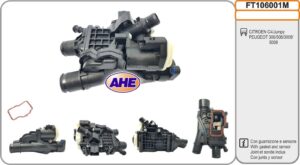
Demand for the product in question as a replacement part is very high. We therefore analyse the causes that lead to the replacement of the thermostat housing, both in general terms and specifically in relation to the PSA 2.0 HDi engine with code DW10.

In general terms, the causes that lead to the replacement of the thermostat housing stem mainly from the following two factors:

  1. Thermal degradation and ageing of the plastic
    The original housing is made of plastic (thermoplastic composite). Over the years, continuous heating cycles (up to over 90°C) followed by cooling tend to crystallise and weaken the plastic.
    This causes:
    – Micro-cracks or cracks in the main body, which produce coolant leaks that are initially invisible because the liquid evaporates immediately on the hot engine block.
    – Deformation of the mating surface, which prevents the gasket from sealing evenly.
    This normally occurs when the engine has covered around 150.000 km.
  2. O-ring failure
    The seal between the housing and the cylinder head relies on a profiled rubber gasket (O-ring). Prolonged exposure to old or unsuitable coolant causes the rubber to harden or flatten prematurely, so that it loses elasticity and starts to seep coolant. In this case too, the problem arises on vehicles that have covered at least 100.000 km.
    The two problems described above are not product defects but result from the use of the product over time. In addition, there are two further causes that stem from external problems and do not depend on the product.
  3. Incorrect tightening during maintenance
    The housing’s fixing points on the cylinder head require very low tightening torques. If the screws were over-tightened during a previous repair, the plastic of the housing cracks instantly around the fixing slots or warps, guaranteeing a leak in the long term.
    For this reason, we always recommend using a torque wrench that applies a uniform tightening value to all points, within the limits specified by the vehicle manufacturer.
  4. Excessive pressure in the circuit (Indirect cause)
    This cause is the specific problem associated with DW10 engines and is the consequence of another defect, namely microfailures of the cylinder head gasket. If the engine suffers even a single major overheating due to another fault (e.g. seized water pump, clogged radiator or thermostat stuck closed), the aluminium cylinder head expands and deforms the gasket within a few minutes, regardless of the vehicle’s age.
    When, following this expansion, combustion gases leak into the cooling circuit, the internal pressure rises beyond normal limits.
    The excessive operating pressure finds its release at the structurally weakest point of the circuit, causing the connections on the plastic housing to break or be pushed out. Simply replacing the housing, with any type of product  whether original or aftermarket), will not solve the problem permanently: it will recur over time depending on how severe the cylinder head gasket failure and the expansion are.


In the event of product returns from customers, we strongly recommend pointing out in particular the issues described in points 3 and 4: since they do not derive from product defects, they may lead to the exclusion of the technical warranty.